


From School Expulsion to Nobel Acclaim: The Story of Gabriela Mistral
January 12, 2026 Hour: 12:28 am
🔗 Comparte este artículo
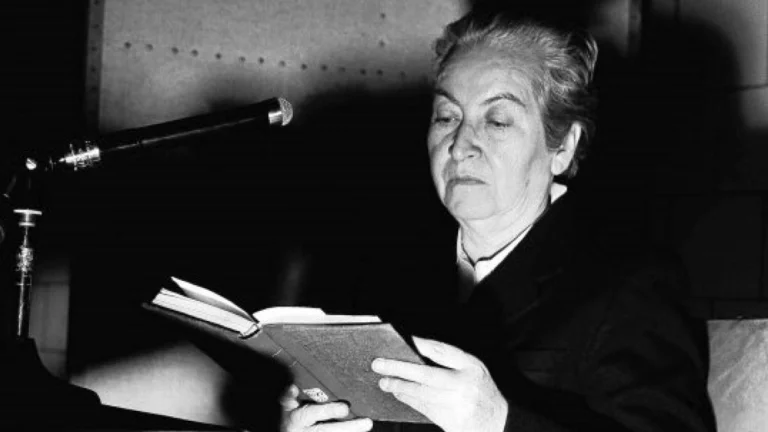
Gabriela Mistral rose from a solitary childhood in Chile’s Elqui Valley to become Latin America’s first Nobel laureate in Literature and one of the 20th century’s most influential cultural figures.
Gabriela Mistral, born Lucila Godoy Alcayaga in 1889, emerged from a solitary childhood in Chile’s Elqui Valley to become the first Latin American Nobel laureate in Literature and a profoundly versatile influence of the 20th century.
RELATED: No Hollywood Ending for A Mining Town Story: Letelier’s “The Film Teller”
Beyond her celebrated poetry, Mistral served as a dedicated educator, a prolific journalist, and a cultural diplomat, holding posts as a Chilean consul in Madrid and serving as a delegate to the United Nations.
From an early age, she exhibited a reclusive nature, preferring the solitude of the family orchard or the simple amusement of stones and fruit pits to the company of other children. The rugged nature and landscapes of the Elqui Valley, along with its peasant communities, were seared into her memory, later rising to vivid life in her poetry.
In 1900, she was withdrawn from Vicuña’s Superior School for Girls just four months after enrolling, following an accusation by the school’s director, Adelaida Olivares, that she had stolen school materials. The charge brought her mockery and aggression from her classmates.
From then on, deprived of formal education, she began to become an enthusiastic and constant autodidact, devouring the books she managed to obtain.
In late 1903, Lucila entered the teaching profession, taking a position as a teacher’s aide at the Compañía Baja school, a village on the outskirts of La Serena. There, she taught children between the ages of 5 and 10, as well as older youth.
Text reads: “In 1957, at the age of 68, Gabriela Mistral or Lucia Godoy Alcayaga died; a Chilean poet, diplomat and teacher who was awarded the Nobel Prize for Literature in 1945. After her death she was buried in the Cathedral of San Patricio in New York, and then moved to Chile to finally rest in the Elqui Valley where she was born and grew up.”
She contributed to literary publications, with her first writings appearing in 1904.
By 1913 she collaborated with the magazine Elegancias, edited by Ruben Dario from Paris. In 1914, she won Chile’s National Poetry Prize with Sonetos de la muerte.
On December 10, 1945, she received the Nobel Prize in Literature.
On the morning of January 10, 1957, she passed away at age 67 in Hempstead General Hospital, Long Island. Within hours, the United Nations General Assembly memorialized her with words of praise, hailing her as the woman whose virtues distinguished her as one of the most valuable personalities of our time.
Her body has rested since March 23, 1960, in her beloved childhood village, thus fulfilling her testamentary will.
Author: Victor Miranda - LVM
Source: caminoagabrielamistral.com